Double entry bookkeeping – for anyone who has studied accounting those 3 words may bring back fond (or frustrating…) memories of hours spent trying to get their head around the intricacies of the system. The good thing about it though is once you understand the concepts it works.
The one thing I remember when I was taught it many years ago is that the word bookkeeping is the only common English word with consecutive triple double letters in it. This fact wasn’t much use in accounting exams though but memorable nonetheless.
Double entry bookkeeping has been around a while. A long time in fact. But who came up with the concept?
Luca Pacioli: The Forefather of Modern Accounting
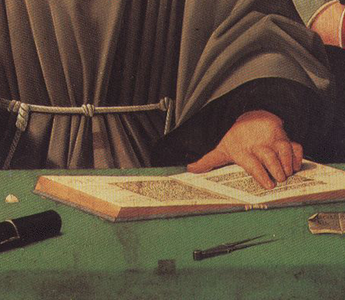
Luca Pacioli, born in 1445 in Sansepolcro, Italy, is considered the father of modern accounting. A Franciscan friar by profession, Pacioli was an erudite scholar with a deep interest in mathematics. In 1494, he published a comprehensive treatise entitled “Summa de Arithmetica, Geometria, Proportioni et Proportionalità,” covering a wide array of mathematical subjects. Remarkably, within this compendium was the world’s first published description of the double-entry bookkeeping system.
Invention or Codification?
However, it’s essential to clarify that Pacioli didn’t actually ‘invent’ double-entry bookkeeping. Rather, he refined and codified an existing practice, providing the first exhaustive explanation and guidelines on its usage. This method had already been in use among the merchants of Venice and Genoa, the economic powerhouses of the time. Their complex trading activities demanded a more organized system of keeping accounts, leading to the development of double-entry bookkeeping.
The Impact of Double-Entry Bookkeeping
The brilliance of the double-entry system lies in its simplicity yet profound impact. Each financial transaction is recorded twice, once as a debit and once as a credit, creating a balance. This meticulous record-keeping method promotes accuracy and offers a comprehensive view of a company’s financial status.
Pacioli’s Lasting Legacy
Pacioli’s work introduced the concept of ledgers, journals, and balancing books, an approach that has stood the test of time. He emphasized the use of accurate records to ensure the integrity of transactions and advocated for systematic verification to minimize errors.
Pacioli’s teachings in the ‘Summa’ were widely disseminated throughout Europe, becoming a reference for merchants and accountants for generations. His work paved the way for modern accounting principles, underlining the importance of clear, systematic, and transparent financial records.
The Continued Relevance of Double-Entry Bookkeeping
Despite having its roots in the late Middle Ages, double-entry bookkeeping continues to be the backbone of financial reporting and auditing today. It’s hard to imagine a world without it, given its significance in maintaining the financial health of organizations across the globe.
In conclusion, while Pacioli might not have been the actual inventor of double-entry bookkeeping, his contribution in refining, formalizing, and popularizing this method cannot be understated. His work was not only groundbreaking for his era but also an enduring legacy that has shaped the face of modern commerce.