Why choose ACCA?
The ACCA (Association of Chartered Certified Accountants) qualification is one of the most globally recognised credentials in accounting and finance. The ACCA difference, at a glance:


Why study with ExP?
ACCA Platinum Approved, exceptional pass rates, global corporate clients, flexible on-demand learning and because...
Everything you need to pass your ACCA exams is included


Experience it for yourself
Get a quick feel for the platform with our 4-minute video demo – or experience it yourself with 7 days of free preview access to the course of your choice. Just click the button below to register.


Trusted. Rated. Recommended.
Don’t just take our word for it — see what real students say about studying with ExP. Learners worldwide rate our courses highly for clarity, tutor support, and exam success, with feedback drawn from independent public reviews and ExP’s own student surveys — giving a genuine picture of the results our learners achieve.

From your first exams to your final papers, ExP's ACCA courses give you the tools to succeed .
Applied Knowledge
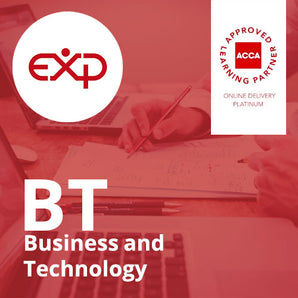
The ACCA Applied Knowledge level introduces the essential principles of accounting, business, and finance. It covers three papers: Business and Technology (BT), Management Accounting (MA), and Financial Accounting (FA). Together, these exams provide a strong foundation of technical knowledge and practical skills to prepare you for the next stages of your ACCA qualification and future career success.


Applied Skills
The ACCA Applied Skills level develops the advanced technical knowledge and practical expertise needed by finance professionals. It covers six papers: Corporate and Business Law (LW), Performance Management (PM), Taxation (TX), Financial Reporting (FR), Audit and Assurance (AA), and Financial Management (FM). Together, these exams strengthen analytical, problem-solving, and professional skills, preparing you for the strategic stage of your ACCA journey.

Strategic Professional - Essentials
The ACCA Strategic Professional Essentials level focuses on leadership, strategy, and professional judgement at the highest level. It includes two compulsory papers: Strategic Business Leader (SBL) and Strategic Business Reporting (SBR). These exams equip you with advanced skills in governance, ethics, corporate reporting, and strategic decision-making, preparing you for senior roles in finance and business.
Strategic Professional - Options
The ACCA Strategic Professional Options level allows you to specialise in areas that match your career goals. You choose two from four papers: Advanced Financial Management (AFM), Advanced Performance Management (APM), Advanced Taxation (ATX), and Advanced Audit and Assurance (AAA). These exams provide in-depth technical expertise and critical thinking skills to become a trusted expert in your chosen field.
What you’ll study in ACCA
Explore the syllabus areas for every ACCA paper, from foundations to advanced specialisms.
Applied Knowledge
The Applied Knowledge exams give you a broad introduction to accounting and finance. You’ll explore how businesses operate, the basics of management accounting, and the principles of financial accounting. Completing this level, along with the Foundations in Professionalism module, awards you the ACCA Diploma in Accounting and Business (RQF Level 4).
Business & Technology (BT): Understand how businesses operate and the critical role finance plays in success. In BT, you'll learn:
- the purpose and types of businesses, and their interactions with stakeholders and the external environment
- the business organisation structure, functions and the role of corporate governance
- the function of accountancy and audit
the principles of authority, leadership and team management - why personal effectiveness is the basis for effective team and organisational behaviour
- why upholding professional ethics and professional values in business is important.
Management Accounting (MA): Learn costing and budgeting skills to support effective decision-making. In MA, you'll learn:
- the nature, source and purpose of management information
- cost accounting techniques
- budgets for planning and control
- comparisons and analysis of variances
- performance measurement and monitoring of business performance
Financial Accounting (FA): Build a foundation in bookkeeping and prepare essential financial statements. In FA, you'll learn:
- to demonstrate technical proficiency in the use of double-entry and accounting systems
- how to record, process and report business transactions
- to understand the context and purpose of financial reporting
- apply the qualitative characteristics of financial information
- how to prepare a trial balance (including identifying and correcting errors)
- how to prepare basic financial statements for incorporated and unincorporated entities
- how to prepare simple consolidated financial statements
- how to interpret financial statements
Applied Skills
Applied Skills builds on your foundations to develop strong, practical finance abilities. You’ll learn to apply management accounting, financial reporting, audit, tax, and business law in real-world contexts. Completion leads to the Advanced Diploma in Accounting and Business, benchmarked at a UK Bachelor’s degree level, and you may also opt to gain a BSc in Applied Accounting with Oxford Brookes University.
Corporate & Business Law (LW): Understand the legal framework that shapes business and finance. In LW, you'll learn to:
- identify the essential elements of different legal systems including the main sources of law, the relationship between the different branches of a state’s constitution, and the need for international legal regulation, and explain the roles of international organisations in the promotion and regulation of international trade, and the role of international arbitration as an alternative to court adjudication
- recognise and apply the appropriate legal rules applicable under the United Nations Convention on Contracts for the International Sale of Goods, and explain the various ways in which international business transactions can be funded
- recognise different types of international business forms
- distinguish between the alternative forms and constitutions of business organisations
- recognise and compare types of capital and the financing of companies
- describe and explain how companies are managed, administered and regulated
- recognise the legal implications relating to insolvency law
- demonstrate an understanding of corporate fraudulent and criminal behaviour
Performance Management (PM): Use management accounting techniques to analyse and improve performance. In PM, you'll learn to:
- explain and apply cost accounting techniques
- select and appropriately apply decision-making techniques to facilitate business decisions, and promote efficient and effective use of scarce business resources, appreciating the risks and uncertainty inherent in business and controlling those risks
- identify and apply appropriate budgeting techniques and methods for planning and control, and use standard costing systems to measure and control business performance and to identify remedial action
- identify and discuss performance management information and measurement systems, and assess the performance of an organisation from both a financial and non-financial viewpoint, appreciating the problems of controlling divisionalised businesses and the importance of allowing for external aspects.
Taxation (TX): Build practical knowledge of tax systems and compliance. In TX, you'll learn to:
- Explain the operation and scope of the tax system and the obligations of tax payers and/or their agents and the implications of non-compliance
- Explain and compute the income tax liabilities of individuals and the effect of national insurance contributions (NIC) on employees, employers and the self-employed
- Explain and compute the chargeable gains arising on individuals
- Explain and compute the inheritance tax liabilities of individuals
- Explain and compute the corporation tax liabilities of individual companies and groups of companies
- Explain and compute the effects of value added tax on incorporated and unincorporated businesses.
Audit & Assurance (AA): Understand how assurance builds trust in financial information. In AA, you'll learn to:
- explain the concept of audit and assurance and the functions of audit, corporate governance, including ethics and professional conduct, describing the scope and distinguishing between the functions of internal and external audit
- demonstrate how the auditor obtains and accepts audit engagements, obtains an understanding of the entity and its environment, assesses the risk of material misstatement (whether arising from fraud or other irregularities) and plans an audit of financial statements
- describe and evaluate internal controls, techniques and audit tests, including IT systems to identify and communicate control risks and their potential consequences, making appropriate recommendations
- identify and describe the work and evidence obtained by the auditor and others required to meet the objectives of audit engagements and the application of the International Standards on Auditing (ISAs)
- explain how consideration of subsequent events and the going concern principle can inform the conclusions from audit work and are reflected in different types of auditor’s report, written representations and the final review and report.
Financial Management (FM): Learn to manage finance, risk and investment to support growth. In FM, you'll learn to:
- discuss the role and purpose of the financial management function
assess and discuss the impact of the economic environment on financial management - discuss and apply working capital management techniques
carry out effective investment appraisal - identify and evaluate alternative sources of business finance
- discuss and apply principles of business and asset valuations
- explain and apply risk management techniques in business
Strategic Professional – Essentials & Options
The Strategic Professional Essentials papers (SBL and SBR) prepare you to make an impact at the highest levels of business. You’ll focus on leadership, governance, ethics, and strategic reporting, applying your skills in realistic case-study scenarios. These exams ensure you’re ready to lead, influence, and communicate effectively with stakeholders worldwide.
The Strategic Professional Options papers let you specialise in areas that fit your career goals. Choose two exams from the following four: Advanced Audit & Assurance, Advanced Financial Management, Advanced Performance Management, or Advanced Taxation. Each option develops technical expertise and professional judgement, giving you the flexibility to shape your ACCA journey to your ambitions.
Strategic Business Leader (SBL): Apply leadership, governance and strategy to real-world business challenges. In SBL, you'll learn to:
- apply excellent leadership and ethical skills to set the ‘tone from the top’ and promote a positive culture within the organisation, adopting a whole organisation perspective in managing performance and value creation.
- evaluate the effectiveness of the governance and agency system of an organisation and recognise the responsibility of the board or other agents towards their stakeholders, including the organisation’s social responsibilities and the reporting implications.
- evaluate the strategic position of the organisation against the external environment and the availability of internal resources, to identify feasible strategic options.
- analyse the risk profile of the organisation and of any strategic options identified, within a culture of responsible risk management.
- select and apply appropriate information technologies and data analytics, to analyse factors affecting the organisation’s value chain to identify strategic opportunities and implement strategic options within a framework of robust IT security controls.
- evaluate management reporting and internal control and audit systems to ensure compliance and the achievement of organisation’s objectives and the safeguarding of organisational assets.
- apply high level financial techniques from Applied Skills exams in the planning, implementation and evaluation of strategic options and actions.
- enable success through innovative thinking, applying best in class strategies and disruptive technologies in the management of change; initiating, leading and organising projects, while effectively managing talent and other business resources.
- apply a range of professional skills in addressing requirements within the Strategic Business Leader exam and in preparation for, or to support, current work experience
Strategic Business Reporting (SBR): Master advanced financial reporting to communicate with stakeholders. In SBR, you'll learn to:
- explain and evaluate the role and responsibility of the senior financial executive or advisor in meeting conflicting needs of stakeholders and recognise the role of international financial institutions in the financial management of multinationals
- evaluate potential investment decisions and assessing their financial and strategic consequences, both domestically and internationally
- assess and plan acquisitions and mergers as an alternative growth strategy
- evaluate and advise on alternative corporate re-organisation strategies
- apply and evaluate alternative advanced treasury and risk management techniques.
Advanced Financial Management (AFM): Develop advanced skills to manage strategic finance and risk. In AFM, you'll learn to:
- explain and evaluate the role and responsibility of the senior financial executive or advisor in meeting conflicting needs of stakeholders and recognise the role of international financial institutions in the financial management of multinationals
- evaluate potential investment decisions and assessing their financial and strategic consequences, both domestically and internationally
- assess and plan acquisitions and mergers as an alternative growth strategy
- evaluate and advise on alternative corporate re-organisation strategies
- apply and evaluate alternative advanced treasury and risk management techniques.
Advanced Performance Management (APM): Provide strategic insights to improve business performance. In APM, you'll learn to:
- use strategic planning and control models to plan and monitor organisational performance
- assess and identify key external influences on organisational performance
- identify and evaluate the design features of effective performance management information and monitoring systems
- apply appropriate strategic performance measurement techniques in evaluating and improving organisational performance
- advise clients and senior management on strategic business performance evaluation and on recognising vulnerability to corporate failure.
Advanced Taxation (ATX): Gain specialist tax expertise for individuals and businesses. In ATX, you'll learn to:
- Apply further knowledge and understanding of the UK tax system through the study of more advanced topics within the taxes studied previously and the study of stamp taxes
- Identify and evaluate the impact of relevant taxes on various situations and courses of action, including the interaction of taxes
- Provide advice on minimising and/or deferring tax liabilities by the use of standard tax planning measures
- Communicate with clients, HM Revenue and Customs and other professionals in an appropriate manner.
Advanced Audit & Assurance (AAA): Tackle complex audits using professional judgement and ethics. In AAA, you'll learn to:
- Recognise the legal and regulatory environment and its impact on audit and assurance practice
- Demonstrate the ability to work effectively on an assurance or other service engagement within a professional and ethical framework
- Assess and recommend appropriate quality control policies and procedures in practice management and recognise the auditor’s position in relation to the acceptance and retention of professional appointments
- Identify and formulate the work required to meet the objectives of audit assignments and apply the International Standards on Auditing (ISAs)
- Identify and formulate the work required to meet the objectives of non-audit assignments
- Evaluate findings and the results of work performed and draft suitable reports on assignments
- Identify and formulate the work required to meet objectives of non-audit assignments
- Understand the current issues and developments relating to the provision of audit-related and assurance services.