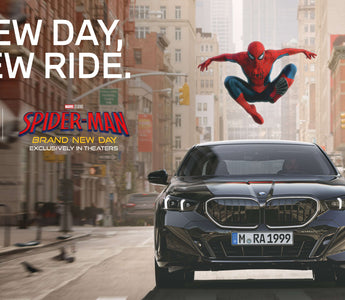
Imagine paying more than £100,000 for a luxury car, switching it on and being greeted by an advert for the latest Spider-Man film.
That is effectively what happened to some BMW owners after the manufacturer used its in-car control screens to promote Spider-Man: Brand New Day.
BMW may have seen it as an imaginative marketing partnership. Some customers saw it rather differently: as an unwanted advert appearing inside a product they already owned.
So, was this clever marketing or a serious misjudgement?
What happened?
BMW partnered with Sony Pictures to promote the latest Spider-Man film, which features a BMW.
Last month, drivers of suitably equipped BMWs were shown a banner on their control display saying:
“Surprise! Spider-Man just dropped into your BMW!”
If the driver selected the banner, a full-screen animation appeared featuring Spider-Man, music and even effects using the car’s ambient lighting.
BMW described the feature as a “special surprise” for customers. It was made available in participating markets on many BMWs manufactured since July 2020. The full animation was optional and could only be activated while the vehicle was stationary.
However, drivers still saw the initial promotional banner when starting the car and that was enough to cause a backlash.
From product placement to product invasion?
Product placement in films is hardly new.
James Bond has been closely associated with Aston Martin for decades. Technology companies pay to have their phones and laptops used by famous characters, while drinks, clothing and car brands regularly appear on screen.
This can benefit everyone involved. The film receives financial support, while the brand gains exposure and an association with a popular character or franchise.
The BMW and Spider-Man partnership therefore makes sense. Spider-Man looks exciting and modern, while BMW wants its cars to be seen in a similar way.
The controversial part was not placing a BMW in the film. It was placing the film inside customers’ BMWs.
That distinction matters.
Who owns the screen after the car is sold?
Modern cars are becoming increasingly similar to smartphones and computers. They contain connected software that can be updated remotely, allowing manufacturers to add features long after the vehicle has left the factory.
That can be extremely useful. Software updates can improve navigation, repair faults and introduce new safety features.
But the same technology gives manufacturers continuing access to a product that the customer may believe belongs entirely to them.
BMW appears to have treated the control screen as another communication channel. Some drivers treated it as part of their private space.
This creates an important business question: when a customer buys a connected product, how much control should the manufacturer retain?
A poor fit with a luxury brand?
The controversy may be particularly damaging because of BMW’s market positioning.
BMW is a premium brand. Its customers pay more because they expect quality, performance and a superior ownership experience. They are not simply buying transport, they are buying status, exclusivity and control.
Advertising usually works best when customers accept that it is part of the deal. People tolerate adverts on free websites, social media platforms and streaming services because advertising helps fund the service.
The situation feels different when someone has already paid a substantial amount for a luxury car.
An advert appearing on its control screen risks making an expensive BMW feel like a cheap, advertising-supported product. Even if the promotion only appeared briefly, it may conflict with the premium image BMW has spent years developing.
Clever targeting or a breach of trust?
From a marketer’s perspective, the campaign has some obvious attractions.
BMW could reach a clearly defined group of relatively affluent consumers. The campaign was interactive, difficult to overlook and connected directly with a car appearing in the film.
Connected technology could also allow BMW to measure how many drivers received the banner and how many chose to view the animation. This provides more useful performance data than traditional product placement, where it can be difficult to measure how many viewers noticed a particular car.
But effective targeting is not automatically acceptable targeting.
Customers may start asking what other information their cars are collecting, how it is being used and whether future promotions will be based on their location, journeys or personal behaviour. Even when a particular campaign does not use all that data, the technology creates understandable concerns about what may happen next.
Marketing depends on more than simply capturing attention. It also depends on permission and trust.
The danger of short-term thinking
The promotion may have generated valuable publicity for BMW and Sony Pictures. It certainly got people talking.
But not all attention is good attention.
Some owners reportedly said they would not buy another BMW. Whether they follow through is another matter, but the reaction highlights the difference between short-term promotional exposure and long-term customer value.
BMW may have gained views and clicks while weakening trust among some of its most valuable customers.
That would be a poor trade-off. A banner may last a few seconds, but a damaged customer relationship can last much longer.
What can business students learn?
This story shows how digital technology is creating new marketing opportunities but also new ethical boundaries.
Businesses need to ask more than “Can we do this?” They should also ask:
* Will customers consider it reasonable?
* Does it fit our brand positioning?
* Have customers genuinely agreed to receive this content?
* Could a short-term campaign damage long-term loyalty?
* Are we collecting or using customer data transparently?
* How would we feel if a competitor used the same tactic?
The campaign may have been innovative, but innovation without a clear understanding of customer expectations can quickly backfire.
For BMW, Spider-Man may have dropped into the car for only a short time. The bigger question is whether in-car advertising is now waiting just around the corner.