A sandwich for lunch might cost a few pounds. Buying the business that organises lunch for thousands of workplaces is rather more expensive.
Earlier this month, Uber announced an agreement to acquire ezCater for $2.3 billion. The US platform helps organisations arrange workplace meals and catering, connecting them with more than 140,000 restaurants. The transaction is expected to close in the coming months, subject to regulatory approvals and other conditions.
For anyone who mainly associates Uber with booking a ride home, it is a reminder of how far a business can expand beyond its original service. For business students, it raises a useful question: why pay billions for something you might be able to build yourself?
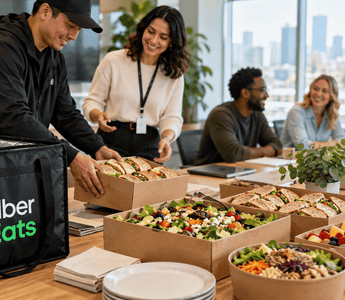
Think about the difference between ordering your own lunch and arranging food for a training day with 80 people.
Your own order is relatively simple. You choose what you want, pay and wait for the delivery. A workplace order could involve dietary requirements, an agreed budget, a fixed arrival time, an invoice and someone who needs to approve the spending.
If your sandwich arrives late, you are annoyed. If lunch for 80 delegates arrives late, an event organiser has a much bigger problem.
This helps explain why business-to-business services can require different capabilities from services aimed at individual consumers. The product may look similar, but the buying process and expectations can be quite different.
Uber says ezCater’s average order value exceeds $400. It wants to combine ezCater’s catering expertise with Uber Eats’ reach and Uber for Business’s corporate relationships.
Larger orders could be attractive, particularly if satisfied customers book again. A company might need meals for regular meetings, staff training or recurring team lunches. Winning that relationship could produce repeat business without having to persuade a new customer every lunchtime.
However, larger orders also bring greater expectations. Reliability, support and the ability to handle complicated requests all cost money.
That is where the decision to buy rather than build becomes interesting.
Developing a catering service internally would give Uber control over its design and expansion. It could spread investment over time and learn as it grows. But recruiting experienced people, establishing restaurant relationships and earning corporate customers’ trust would take time.
An acquisition offers a faster route to those capabilities. The buyer gains an operating business with systems, people and customer relationships already in place. The price includes the value of avoiding some of the time and uncertainty involved in starting from scratch.
It also creates integration risk. Technology may need connecting, teams may work differently, and customers may worry that the service they like will change. The transaction only delivers its intended benefits if those practical issues are managed well.
Buying a business secures ownership. Making the combination work is a separate management task.
There is an important accounting distinction in the announcement too. Uber reported that ezCater generated more than $2.5 billion in gross bookings over the preceding 12 months. Gross bookings measure the value of transactions through the platform; they should not be treated as the platform’s revenue or profit.
To illustrate, imagine a platform processes a £500 catering order and earns a £50 commission for arranging it. In this simplified example, assuming it acts as an agent and earns no other fees, the £500 is the booking value, while its revenue is £50. Its own operating costs must still be deducted to calculate profit.
Those are hypothetical figures, not ezCater’s actual fees. They show why comparing an acquisition price with the value of orders alone can be misleading.
To assess whether the deal makes financial sense, managers would need to examine future cash flows, customer retention, integration costs and the additional business the combination could generate. They should also test what happens if those benefits arrive later than expected.
There is a wider strategic question here: how far can Uber extend its existing capabilities before expansion becomes a distraction? Workplace catering has a connection to food delivery, but success still depends on meeting the specific needs of corporate buyers.
The headline is a $2.3 billion purchase. The everyday test will be much simpler: can the right food reach the right people, on time, at a profit?